Ad Density and User Experience: Finding the Right Balance in 2026
Introduction: The Pendulum Swings from Quantity to Quality
For years, the conventional wisdom in digital publishing was simple: more ads equal more revenue. Fill every available space, stack the placements, and maximize the number of impressions served. This volume-driven approach delivered short-term gains but created a long-term problem: users grew fatigued, banner blindness became endemic, and the very foundation of publisher revenue—trust and engagement—began to erode.
In 2026, that era is decisively ending.
The advertising industry is experiencing a fundamental reorientation. With 91% of users already ignoring social ads and most consumers reporting their feeds have “too many ads,” overload and repetition are driving performance down. Fatigue cuts click-through rates by a third and raises cost-per-click by about 20% . The math is inescapable: more ads are producing less value for everyone.
This guide provides a comprehensive framework for publishers navigating the critical balance between ad density and user experience. Drawing on 2026 data, industry research, and proven optimization strategies, you will learn how to measure the right metrics, design for attention rather than volume, and build a monetization strategy that prioritizes long-term audience relationships over short-term impression counts.
Part 1: The New Reality – Why Ad Density Matters More Than Ever
1.1 The Fatigue Factor: Consumers Are Tuning Out
The “attention economy” that has driven digital advertising for the past decade is showing unmistakable signs of collapse. Industry leaders are sounding the alarm:
*”What started as fatigue becomes outright avoidance. In 2026, consumers won’t just tune out social ads; they’ll choose platforms specifically because they’re less ad-dense.”* — Chris Gadek, CEO of AdQuick
This is not anecdotal speculation; it’s backed by data. Ninety-one percent of users already ignore social ads, and the majority believe their feeds contain “too many ads” . The consequences are measurable: fatigue cuts click-through rates by a third and raises cost-per-click by approximately 20% .
1.2 The Quality Revolution: Advertisers Demand Better
Simultaneously, the buy side is evolving. Programmatic advertising budgets continue to chase efficiency and performance, which translates to sustained downward pressure on open market CPMs . The only sustainable defense for publishers is creating differentiated value that commands premium pricing.
Key industry shifts for 2026:
As one industry analyst notes: “Buyers want confidence in quality, targeting and outcomes, pushing more budget toward curated inventory and walled-garden platforms” .
1.3 The Attention Economy Is Dead – Long Live the Engagement Economy
Perhaps the most significant shift is philosophical. The industry is moving from measuring served impressions to measuring human attention:
“The ‘attention economy’ is dead. We are entering a renaissance for long-form, authentic content as ‘snackable’ media becomes overly saturated and commoditized by AI. Brands that invest in deep, valuable and well-crafted long-form reads, videos and stories will win.” — Jordan Leschinsky, Codeword
This shift has profound implications for ad density. Pages cluttered with low-value inventory signal low-quality environments to both users and advertisers. Clean, focused layouts signal the opposite: a premium destination worthy of attention.
Part 2: The Metrics That Matter – Moving Beyond Vanity
2.1 Why Fill Rate Is Misleading
Fill rate—the percentage of ad requests that receive an ad—has historically been a primary publisher metric. It’s intuitive: higher fill rate means more inventory sold. But this metric hides a uncomfortable truth.
The reality: Only 1 in 100 ad requests actually receives a bid. The rest disappear due to strict buyer filtering, poor placement visibility, slow load times, or low-quality signals . A perfect 95-100% fill rate often means you’re accepting low-value ads just to keep the metric high, sacrificing long-term revenue for short-term vanity .
Key insight from AdPushup: “A perfect fill rate may hide the fact that half your impressions never make it into a user’s view. Invisible ads don’t generate revenue” . Google research confirms that 56% of display ads go unseen, often buried below the fold or ignored in less than a second .
2.2 The New Trinity: Attention-Driven Metrics
In 2026, sophisticated publishers track three metrics that directly correlate with both user experience and revenue.
The relationship is straightforward: cleaner pages lead to longer reading times, higher viewability, better placement performance, stronger brand advertiser interest, and higher eCPMs .
2.3 ARPU and LTV: The Ultimate Measures
Beyond individual ad metrics, successful publishers are adopting a user-centric measurement framework. Average Revenue Per User (ARPU) and Lifetime Value (LTV) provide the holistic view necessary for evaluating the ad density trade-off.
“A lighter ad experience that reduces short-term revenue per session may increase total revenue by driving repeat visits, longer sessions and higher engagement over time. Optimize for user value, not just pageview yield.”
This reframing is critical. A high-density page might generate more revenue in a single session, but if it drives users away permanently, the long-term cost far exceeds the short-term gain.
Part 3: The Research – What the Data Says About Ad Density
3.1 The Case of The Financial Times
The Financial Times pioneered a revolutionary approach with its Cost Per Hour (CPH) model, where advertisers buy actual human attention instead of pixel impressions. The results demonstrated that cleaner pages lead to:
The underlying principle is now widely accepted: Fewer ads = more attention = higher revenue.
3.2 The 30% Threshold
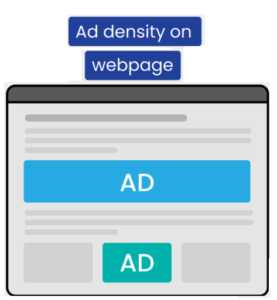
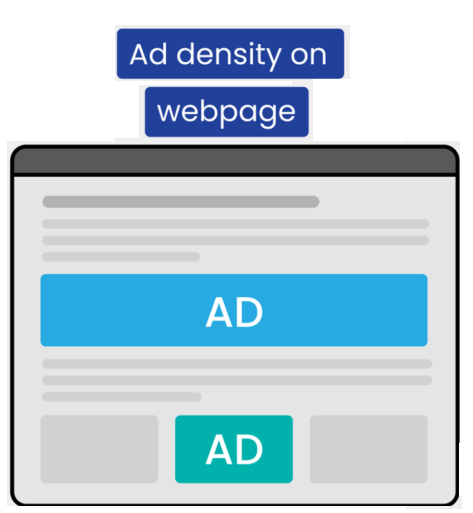
Research indicates that pages with over 30% ad density often signal low-quality inventory to both users and algorithms, lowering effectiveness by up to 55% . This threshold appears to be a tipping point where the negative impacts of density—slow load times, poor readability, banner blindness—outweigh any incremental revenue from additional placements.
3.3 Viewability Benchmarks
The Media Rating Council standard requires 50% of an ad’s pixels to be visible for at least one second to count as viewable . High-density pages struggle to meet this benchmark because:
Ads placed “below the fold” may never be scrolled into view
Slow load times cause users to leave before ads render
Banner blindness means users actively ignore ad-dense areas
Part 4: The Density Trade-Off – A Publisher’s Decision Framework
4.1 The Fundamental Equation
Every ad placement represents a trade-off between:
The optimal density is not zero—ads are how publishers fund content—but it is almost always lower than the maximum technically possible.
4.2 User Segmentation Strategy
Sophisticated publishers apply different density strategies to different user segments :
This segmentation requires user registration as the foundational capability. Registered users enable segmentation by traffic source, content type, and life cycle stage—the building blocks for differentiated monetization .
Practical tip: Identify your highest-value content and gate it behind lightweight registration (email only, no password required). This builds your first-party data asset while creating a clear value exchange for users .
4.3 The 2026 Publisher’s Checklist
Before adding any new ad placement, ask:
Will this ad be viewable? Is it above the fold or in a high-scroll zone?
What is the expected time-in-view? Will users linger long enough for meaningful exposure?
How does this affect page speed? Will it trigger layout shifts or delay content rendering?
What is the opportunity cost? Could this space be better used for engagement features or premium formats?
How will this affect qCPM? Will it signal quality or clutter to programmatic buyers?
Part 5: Implementation Strategies – Optimizing for Attention
5.1 Strategic Reduction: Quality Over Quantity
The most effective density optimization often involves removing placements, not adding them.
High-impact reduction strategies:
5.2 High-Impact Format Selection
Not all ad formats are created equal. Some naturally command higher attention and justify their density.
Premium formats for 2026:
5.3 Lazy Loading and Viewability Optimization
Lazy loading—loading ads only when they’re about to enter the viewport—is no longer optional. It:
Implementation tip: Configure lazy loading with appropriate thresholds (e.g., load when ad is 200px from entering viewport) to balance user experience with revenue capture.
5.4 Designing for Engagement
“Clean designs and fast-loading pages increase engagement, viewability, and time-in-view—all of which drive higher eCPM” .
Design principles for attention optimization:
Strategic whitespace improves readability and makes ads more noticeable
Clear content hierarchy guides users naturally past ad placements
Mobile-first layouts ensure ads display appropriately on all devices
Stable layouts prevent disruptive shifts that frustrate users
Part 6: The Buyer’s Perspective – What Advertisers Actually Want
6.1 Following the Money
To succeed in 2026, publishers must understand what buyers optimize for and engineer inventory to deliver it . Programmatic budgets are shifting from open exchanges to:
Curated deals (packages of premium inventory assembled by publishers or SSPs)
Private marketplaces (PMPs) with select buyers
Programmatic guaranteed direct deals
These channels command premium pricing because they offer something the open market cannot: confidence in quality, targeting, and outcomes.
6.2 What Premium Buyers Look For
6.3 The SSP Partnership
If you’re not in a sales organization, your gateway to buyers is through SSP curation packages. Educate your partners on what makes your inventory special and make it easy for them to curate your inventory . This means:
Providing detailed audience insights
Highlighting unique content verticals
Offering flexible packaging options
Maintaining consistent quality standards
Part 7: The 2026 Publisher’s Playbook – Five Essential Strategies
7.1 Understand Your Users
“Who are they, how do they discover your content and why do they engage with it? With these fundamentals, you can build meaningful relationships that drive monetization” .
Action items:
Implement user registration for anonymous tracking
Segment by traffic source, content type, and lifecycle stage
Calculate ARPU and LTV by segment
Use these insights to inform density decisions
7.2 Create Value for Advertisers
“Protect your inventory by delivering outcomes, not just impressions” .
Action items:
Develop curated inventory packages for key advertiser verticals
Partner with SSPs on curation initiatives
Engineer placements for maximum viewability and attention
Maintain strict brand safety controls
7.3 Optimize Relentlessly
“The opportunities are in the details” .
Action items:
Review performance data daily
Audit technical setup for bid density issues
Optimize viewport ad layouts for common screen dimensions
Review block lists to balance safety with revenue
7.4 Innovate Where It Matters
“Separate ad tech innovation from publisher monetization innovation” .
Action items:
Focus near-term energy on editorial products creating premium sponsorship moments
Build first-party data strategies enabling better targeting
Form partnerships with complementary publishers for scaled curation deals
7.5 Test, Learn, Optimize Continuously
Regular A/B testing identifies which layouts, formats, or placements truly drive revenue . Monetization is not a set-it-and-forget-it proposition; it is a long-term optimization process requiring ongoing attention.
Part 8: Common Mistakes and How to Avoid Them
Part 9: The Future – Beyond the Screen
Looking beyond 2026, the very nature of screen-based interaction is evolving. Industry leaders predict:
“We’ll see the beginning of the end for screen-based interaction as technology moves beyond typing, clicking and swiping into a more ambient, intuitive and anticipatory ecosystem of voice commands, intelligent devices and proactive AI agents” .
For marketers, this means designing new models of interaction, shifting focus from capturing attention on a screen to providing utility in the world—and perhaps finally allowing users to experience the world outside the confines of their phones .
The publishers best positioned for this future are those focusing on what makes them valuable today: deep audience relationships that create differentiated monetization opportunities .
Conclusion: The Balance Is the Business
The question of ad density versus user experience is not a technical puzzle to be solved once and optimistically forgotten. It is a continuous strategic tension that defines the publisher’s relationship with both audiences and advertisers.
The winning publishers of 2026 share common characteristics:
They understand their users at a segment level, not just as aggregate traffic numbers.
They optimize for attention metrics—vCPM, time-in-view, qCPM—rather than vanity measures like fill rate.
They design for engagement, creating clean, fast-loading environments where ads can actually be seen.
They build first-party data assets that command premium pricing from advertisers.
They maintain operational discipline, obsessing over daily performance data and continuous optimization.
The industry consensus is clear: fewer, better-quality ads consistently outperform high-density clutter . Pages with over 30% ad density signal low-quality inventory, while strategic whitespace improves readability, engagement, and ultimately revenue .
*”The publishers best positioned for 2026 are focusing on what makes them valuable: deep audience relationships that create differentiated monetization opportunities. They’re balancing optimization with sales capability. They’re building first-party data assets while maintaining operational excellence in the details”* .
The open market will remain an important revenue channel, but growth increasingly comes from the strategies outlined above. These fundamentals have always been important differentiators for publishers. In 2026, they are becoming critical to sustainable success.
The balance is not a compromise. It is the business itself.