Camera Hardware Explained: What Megapixels Really Mean vs. Sensor Size vs. Aperture
Introduction: The Language of Light
Walk into any smartphone store, and the sales pitch is predictable: “This phone has a 108-megapixel camera!” The implication is clear—more megapixels must mean better photos. It’s a simple, intuitive story that has driven consumer camera marketing for two decades.
It is also largely misleading.
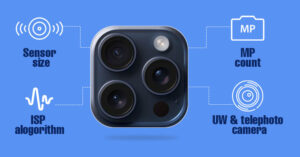
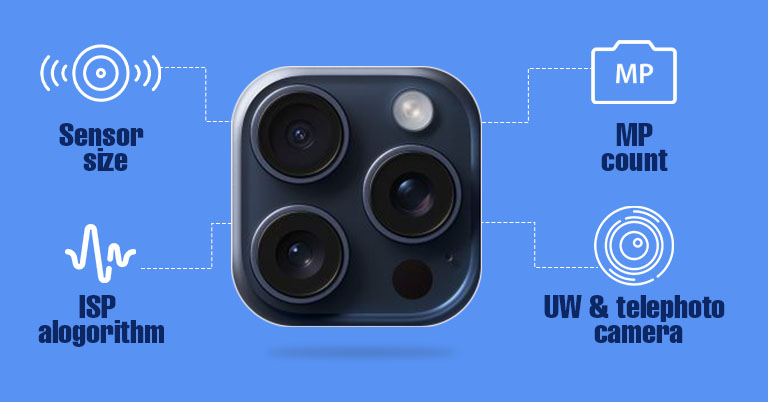
The truth about camera hardware is more nuanced and, for the average user, more empowering. Megapixels matter, but they are just one piece of a three-part puzzle that determines image quality. The other pieces—sensor size and aperture—often play far more significant roles in whether your photos look stunning or disappointing.
This guide cuts through the marketing jargon to explain what these terms actually mean, how they interact, and—most importantly—what you should actually look for when evaluating a camera, whether in a smartphone, a dedicated camera, or any other device.
Part 1: The Foundation – How a Camera Captures Light
Before understanding the components, you must understand the process. Every camera, from a professional DSLR to a smartphone, works on the same fundamental principle :
Light enters the camera through the lens
The aperture determines how much light passes through
The lens focuses the light onto the sensor
The sensor captures the light and converts it into digital data
The processor interprets this data to create the final image
This is often explained through the rain bucket metaphor . Imagine you’re trying to collect rainwater in a bucket. The amount you collect depends on three factors:
The bucket’s width – how much surface area you have to catch rain (this is your aperture and sensor size)
The time you leave it in the rain – how long you expose the sensor to light (this is your shutter speed)
The amount you want to collect – how sensitive the sensor is to the light it receives (this is your ISO)
A “good” photo is simply one where these three factors are balanced correctly. Understanding megapixels, sensor size, and aperture helps you understand how well your camera can achieve this balance under different conditions.
Part 2: Megapixels – The Resolution Myth
2.1 What a Megapixel Actually Is
A megapixel (MP) is a unit of measurement equal to one million pixels. It represents the total number of pixels in an image. If a camera sensor is 4000 pixels wide and 3000 pixels tall, multiplying these numbers gives 12,000,000 pixels—or 12 megapixels .
Resolution, then, is simply a measure of how many individual points of data make up your image. Higher resolution means more pixels, which theoretically means more detail and the ability to print larger photos without visible pixelation .
2.2 The Hidden Trade-Off: Pixel Size
Here’s where the marketing story breaks down. On any given sensor, the total area is fixed. If you increase the number of megapixels, you must decrease the size of each individual pixel to fit them all on the same sensor .
This trade-off has real consequences. Pixel size, measured in micrometres (μm) , determines how much light each individual pixel can capture . Larger pixels have a higher signal-to-noise ratio—they capture more light (signal) relative to random electronic interference (noise). Smaller pixels capture less light and produce noisier images, especially in dim conditions .
DxOMark, a leading camera testing organization, explains it clearly: “For example, for a camera with 48 MP and pixel size of 1.22 µm, the sensor area is 71.44 mm². A larger sensor with the same number of pixels could have larger individual pixels, and therefore better low-light performance” .
The key insight: A 48-megapixel camera with a small sensor and tiny pixels may actually produce worse images than a 12-megapixel camera with a larger sensor and bigger pixels, particularly in low light.
2.3 The Pixel Binning Solution
Smartphone manufacturers have developed a clever workaround to this trade-off: pixel binning. This technology combines data from multiple adjacent pixels to function as a single, larger pixel .
For example, a 50-megapixel sensor might output 12.5-megapixel images by binning pixels in groups of four. The resulting image has lower resolution but significantly better light capture and reduced noise. This is why many high-megapixel smartphone cameras default to lower-resolution output—they’re prioritizing image quality over raw pixel count.
2.4 When Megapixels Actually Matter
So when do megapixels make a real difference? In three specific scenarios :
Large prints: If you’re printing billboards or wall-sized posters, you need every pixel you can get. For typical 4×6 inch prints or social media sharing, 8-12 megapixels are more than sufficient.
Heavy cropping: Wildlife photographers, sports shooters, and others who frequently crop images benefit from extra resolution. More pixels mean more detail remaining after you zoom in.
Digital zoom: Cameras that rely on digital zoom essentially crop the image. Higher resolution gives you more room to “zoom” before quality degrades.
For the vast majority of users in 2026, the megapixel race has become largely irrelevant. A 12-megapixel sensor with large pixels will outperform a 108-megapixel sensor with tiny pixels in almost every real-world scenario except those listed above.
Part 3: Sensor Size – The True King of Image Quality
3.1 What Sensor Size Means
Sensor size refers to the physical dimensions of the camera’s light-capturing chip. It is typically expressed in inches, such as 1/2.55″ or 1″ . However, these measurements are historical artifacts dating back to video camera tubes and don’t directly translate to actual dimensions . A “1-inch sensor” actually measures approximately 13.2 × 8.8 mm—not 25.4 mm.
What matters is the relative size. Larger sensors have more surface area to capture light, which directly translates to better image quality, especially in challenging conditions .
3.2 The Light-Gathering Advantage
The fundamental physics is simple: more surface area = more light. DxOMark’s analysis shows that larger sensors consistently achieve higher scores for both texture (detail) and noise, particularly in low-light conditions .
Consider the gains in recent years. Apple doubled the light-sensitive surface area between the iPhone 12 Pro Max and iPhone 15 Pro Max, corresponding to a gain of one full stop of light . The Oppo Find X6 Pro, with its 1-inch sensor, has double the area of the iPhone 15 Pro Max—another full stop advantage.
In the graph below, DxOMark demonstrates that small sensors have a clear limit in the texture-noise compromise they can achieve, while large sensors can reach significantly higher levels of both :
DXOMARK Low-light texture and noise scores: Small sensors hit a ceiling, while large sensors can achieve both better detail and less noise.
3.3 Sensor Sizes Compared
To understand the scale, here are common sensor sizes and their approximate areas :
A full-frame sensor has approximately 35 times the surface area of a typical 1/2.5″ smartphone sensor . This staggering difference explains why dedicated cameras still outperform phones in challenging conditions, despite all the computational wizardry packed into modern devices.
3.4 The Depth of Field Trade-Off
Larger sensors aren’t universally better—they come with trade-offs. One significant difference is depth of field, which is the range of distance in which objects appear acceptably sharp .
A larger sensor paired with a bright lens creates a shallower depth of field. This is desirable for portraits, where a blurred background (bokeh) makes the subject stand out . However, it can be problematic for landscape photography or group portraits, where you want everything from foreground to background in focus .
Smartphone cameras, with their tiny sensors, have inherently deep depth of field. An iPhone 6S with an f/2.2 aperture produces depth of field equivalent to a full-frame camera set to approximately f/13 or f/14 . This makes it nearly impossible to get that professional portrait look with natural background blur—which is why phones rely on software-based portrait modes to simulate the effect.
Part 4: Aperture – The Gateway for Light
4.1 What Aperture Means
Aperture refers to the size of the opening in the lens through which light enters the camera . It’s measured in f-stops, written as f/1.8, f/2.2, f/4, and so on.
Here’s the counterintuitive part: A lower f-stop number means a wider aperture (larger opening). A higher f-stop number means a narrower aperture (smaller opening) .
The f-stop is actually a mathematical ratio—the focal length of the lens divided by the diameter of the aperture opening. For a 50mm lens, an aperture opening of 25mm gives you f/2 .
4.2 The Two Effects of Aperture
Aperture affects your photos in two primary ways :
1. Light Gathering:
A wider aperture (lower f-number) allows more light to reach the sensor in a given time. This is crucial in low-light situations, enabling faster shutter speeds and reducing the risk of blurry photos from camera shake or moving subjects.
2. Depth of Field:
A wider aperture creates a shallower depth of field, with less of the image in focus and more background blur. A narrower aperture (higher f-number) increases depth of field, keeping more of the scene sharp from foreground to background .
4.3 Why Aperture Affects Depth of Field
The relationship between aperture and depth of field is explained through the concept of the circle of confusion (CoC) . When light rays from a point source pass through a lens, they form a cone. If the tip of that cone hits the sensor exactly, you get a sharp point. If the sensor is slightly in front of or behind that point, the cone creates a circle rather than a point—the circle of confusion.
A wider aperture creates a wider cone of light. As that cone intersects the sensor at any point other than the exact focal plane, it creates a larger circle of confusion, making out-of-focus areas appear more blurred. A narrower aperture creates a narrower cone, so even if the sensor isn’t at the perfect focal point, the circle of confusion remains small—and the image appears sharper over a greater depth .
4.4 Smartphone Apertures: Fixed vs. Variable
Most smartphone cameras have fixed apertures. You cannot adjust them like you can on a dedicated camera . Manufacturers choose a single aperture that balances light-gathering ability with depth of field across common shooting scenarios.
In 2026, most flagship smartphones feature apertures around f/1.5 to f/1.9 for their main cameras—very wide by historical standards, allowing excellent light capture but creating extremely shallow depth of field potential. However, because smartphone sensors are so tiny, the effective depth of field remains quite deep .
Some recent smartphones have experimented with variable aperture technology, typically offering two or three aperture settings to provide more creative control, but this remains rare.
Part 5: How They Work Together – The Interplay of Factors
Understanding each component individually is necessary but insufficient. The magic—and the confusion—comes from how they interact.
5.1 The Exposure Triangle
Aperture, shutter speed, and ISO form the exposure triangle . Change one, and you must adjust another to maintain proper exposure.
Aperture controls light through opening size
Shutter speed controls light through duration
ISO controls the sensor’s sensitivity to light
In smartphone photography, most of this is handled automatically by the camera’s software. But understanding the trade-offs helps you understand why photos sometimes fail:
In low light, the camera may open the aperture fully (good), slow the shutter (risk of blur), and increase ISO (risk of noise)
In bright light, it may narrow the aperture and speed up the shutter to prevent overexposure
5.2 Sensor Size + Aperture = Light Gathering Potential
The total light-gathering capability of a camera is determined by both sensor size and aperture. A large sensor with a wide aperture captures vastly more light than a small sensor with a narrow aperture.
However, sensor size and aperture also interact in ways that affect depth of field. A full-frame camera at f/2.8 produces much shallower depth of field than a smartphone at f/1.8, because the larger sensor magnifies the effect of the aperture .
5.3 Megapixels + Sensor Size = Pixel Size
This is perhaps the most important relationship for understanding real-world performance. Pixel size = Sensor area ÷ Number of pixels.
A 48MP sensor on a 1/2.55″ smartphone sensor has tiny pixels (around 0.8μm). A 12MP sensor on the same physical sensor would have pixels four times larger (around 1.6μm), capturing significantly more light each. This is why some manufacturers prioritize lower megapixel counts on larger sensors—the individual pixel quality often matters more than the total count.
5.4 The Computational Photography Factor
All of this hardware interacts with increasingly sophisticated computational photography . Modern smartphones use multiple frames, AI enhancement, and sophisticated algorithms to overcome hardware limitations.
Google’s “Add Me” feature, which creates seamless group photos including the photographer, and Apple’s Deep Fusion, which optimizes texture and noise pixel-by-pixel, are examples of software making hardware limitations less relevant .
However, as DxOMark notes: “Having great hardware helps with the tuning because it transmits better information to the camera app. For big sensors, the signal is better for noise and texture” . Good software can’t fix fundamentally poor hardware inputs.
Part 6: Real-World Implications – What This Means for Your Photos
6.1 Low-Light Performance
What matters most: Sensor size and aperture.
In low light, you’re fighting for every photon. A larger sensor captures more total light. A wider aperture allows more light in during the exposure. The combination determines whether your evening shots are usable or noise-filled failures .
DxOMark’s data shows that flagship smartphones with 1-inch sensors now achieve low-light performance that was impossible for phones just a few years ago . The gap between smartphones and dedicated cameras is narrowing, but physics still favors larger sensors.
6.2 Portrait Mode and Background Blur
What matters most: Sensor size and software.
For natural background blur (bokeh), you need shallow depth of field—which requires a combination of large sensor and wide aperture . Smartphones can’t achieve this naturally due to their tiny sensors, which is why they rely on software-based portrait modes that blur the background artificially.
These computational approaches have become remarkably good, but they can still struggle with complex edges (hair, glasses) and sometimes produce unnatural-looking blur .
6.3 Landscape and Group Photos
What matters most: Resolution and depth of field.
For landscapes, you want maximum detail (where higher megapixels help) and deep depth of field (where small sensors actually help) . Smartphones excel here—their tiny sensors ensure everything from foreground to background is sharp, while modern processing ensures good detail.
6.4 Zoom and Telephoto
What matters most: Lens design and sensor resolution.
Optical zoom requires physical lens movement, which is difficult in thin smartphones. Most phones use multiple fixed lenses (wide, ultra-wide, telephoto) rather than true zoom . When you “zoom” beyond the telephoto lens, you’re cropping—and that’s where higher megapixels help, giving you more pixels to crop before quality degrades.
Part 7: What to Look For – A Buyer’s Guide
7.1 For Smartphone Buyers
When evaluating smartphone cameras, ignore the megapixel count on the spec sheet. Instead :
The real-world test is simple: look at sample photos, especially in low light. Does the camera preserve detail while keeping noise under control? Are colors accurate? Is focus fast and reliable? No spec sheet can answer these questions.
7.2 For Dedicated Camera Buyers
The same principles apply but with more variables :
Full-frame sensors offer the best image quality and shallow depth of field, but with larger, heavier lenses
APS-C and Micro Four Thirds offer excellent quality in more portable packages
1-inch sensor cameras (like the now-discontinued Sony RX100 series) offered remarkable quality in pocketable formats
Your choice depends on your priorities: absolute image quality, portability, zoom range, or budget.
Part 8: The Future – Where Camera Technology Is Headed
8.1 The 1-Inch Sensor Proliferation
The trend toward larger sensors in smartphones is accelerating. After years of tiny sensors, manufacturers are finding ways to fit 1-inch class sensors into flagship devices . This represents the single biggest improvement in smartphone photography in years.
8.2 Computational Photography Maturity
AI-powered photography continues to evolve. Scene recognition, multi-frame fusion, and generative AI enhancements are becoming standard . The challenge for manufacturers is balancing computational enhancements with natural-looking results.
8.3 Variable Aperture Returns
Some manufacturers are reintroducing variable aperture technology, giving users more creative control over depth of field . This trend may accelerate as sensors grow larger and depth of field becomes shallower.
8.4 The Physical Limits
There are physical limits to how large sensors can be in smartphones. The device must remain thin enough to hold comfortably. Future gains will come from:
Conclusion: The Truth Beyond the Numbers
The megapixel myth persists because it’s simple. One number, easily compared, with higher clearly meaning better. But camera technology, like most things, is not that simple.
The hierarchy of importance is clear:
Sensor size – The foundation. All else being equal, larger sensors capture more light, produce less noise, and enable better images in all conditions.
Aperture and lens quality – The gateway. A wide aperture and high-quality glass ensure that light reaches the sensor cleanly and efficiently.
Pixel size and technology – The efficiency. How well each pixel captures and processes the light it receives.
Megapixels – The resolution. How many pixels you have to work with, which matters primarily for large prints and heavy cropping.
A 12-megapixel camera with a large sensor, wide aperture, and advanced pixel technology will outperform a 108-megapixel camera with a tiny sensor and narrow aperture in almost every real-world scenario.
The next time you’re shopping for a camera—whether in a smartphone or a dedicated device—look beyond the headline number. Ask about sensor size. Check the aperture. Look at sample photos in challenging conditions. The numbers matter, but only when you understand what they actually mean.
Megapixels sell cameras. Sensor size and aperture take great photos.