The Framework Laptop: A Deep Dive into the Right-to-Repair Revolution
In an industry where sleek, sealed designs have become the unquestioned norm, the Framework Laptop arrives not as a mere product, but as a manifesto. It challenges a fundamental tenet of modern consumer electronics: that disposability and planned obsolescence are acceptable costs for thinness and performance. This is a comprehensive review of what it’s like to live with a laptop engineered for repair, upgrade, and longevity—and whether the reality lives up to the revolutionary promise.
The Philosophy: More Than a Laptop, a System
Framework’s core thesis is simple yet radical: a high-performance laptop can be thin, powerful, and completely user-repairable and upgradeable. Every aspect of its design serves this goal. Unlike traditional laptops, which use copious amounts of glue, proprietary screws, and complex ribbon cables, the Framework is built with standard screws and a modular, tool-free architecture.
This philosophy targets three major pain points in the industry:
The High Cost of Repair: A cracked screen or dead keyboard on a typical ultrabook often requires a costly, whole-top-case replacement.
Forced Obsolescence: Many laptops cannot have their RAM or storage upgraded, locking users into their initial purchase specs.
E-Waste: The inability to repair or upgrade a single component leads to the discarding of entire, often functional, devices.
The Hardware: Modularity in Practice
The Framework Laptop’s design is an exercise in elegant engineering. Our review unit is the 13.5-inch model (now succeeded by the Framework Laptop 16 for larger needs), but the principles apply across the lineup.
1. The Modular Ecosystem:
The magic lies in the modules. The most iconic feature is the Expansion Card system. Four USB-C ports on the sides are not soldered; they are individual, hot-swappable modules. You can configure them with a mix of USB-C, USB-A, HDMI, DisplayPort, MicroSD, Ethernet, or extra storage. Need more ports for a desk setup? Swap them in seconds. Traveling light? Pop in a couple of slim USB-C blanks.
2. The Internal Architecture:
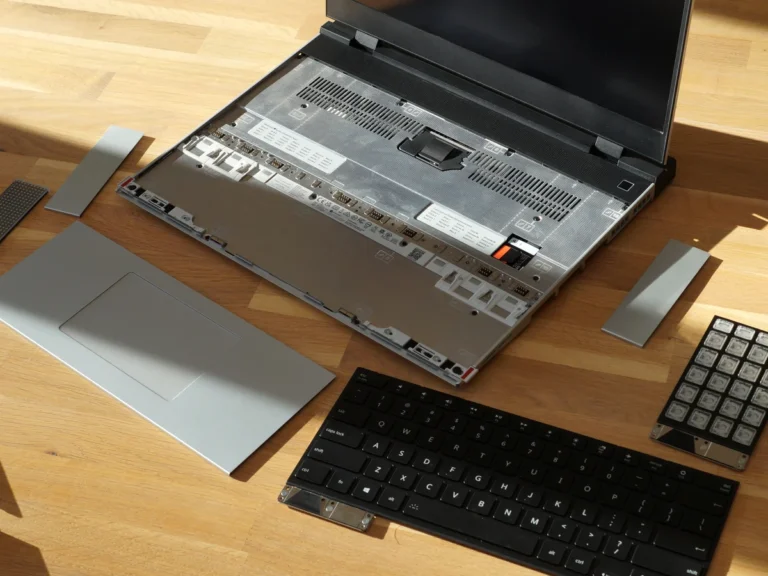
Opening the laptop requires a single, standard Phillips #00 screwdriver. The bottom case snaps off magnetically, revealing a stunningly organized interior. Every critical component is a separate, labeled module:
The Mainboard: The heart of the system, featuring the CPU (from Intel 11th Gen to the latest Intel Core Ultra processors).
The Memory & Storage: Standard DDR4/DDR5 SO-DIMM slots and an M.2 2280 SSD slot—the same parts you’d buy for a desktop PC. Upgrading is as simple as clicking the RAM in or screwing in a new SSD.
The Input Modules: The keyboard, touchpad, and even the display bezel are individual parts. Spilled coffee on the keyboard? Order a new keyboard module (available in multiple languages and layouts) and replace it in 5 minutes with no cables to disconnect.
The Battery & Speakers: These are also easily removable modules, held in by a few screws.
3. The Input Cover System:
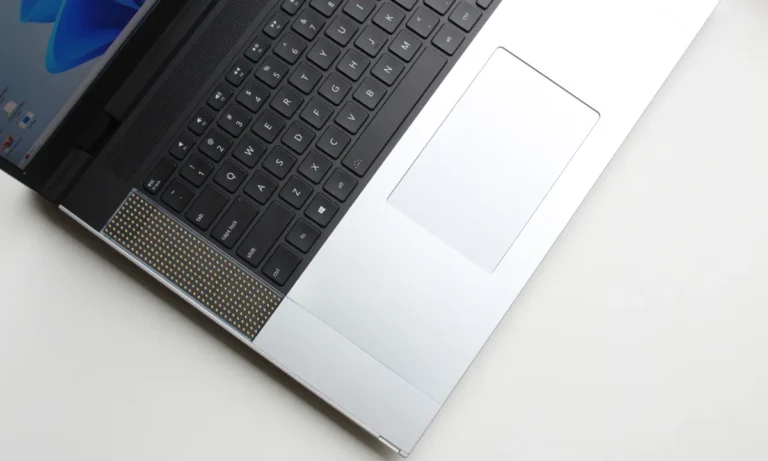
A groundbreaking feature is the swappable Input Cover. You can change the entire look of the laptop’s top case (where the keyboard and touchpad sit) or, more importantly, upgrade the touchpad to a new version without replacing the whole machine.
The Right-to-Repair Experience: A Real-World Test
The theory is impressive, but how does it work in practice? We deliberately created two common repair scenarios.
Scenario 1: Screen Replacement
On a typical ultrabook, this is a nightmare of heat guns, prying tools, and high risk. On the Framework:
Remove the bottom case and disconnect the battery (a critical safety step).
Unscrew the six display hinge screws from the mainboard.
Gently disconnect two ribbon cables (the display and webcam).
The entire display assembly lifts out. The new one slots in, and you reverse the process.
Time: Under 15 minutes. Difficulty: Low. This alone can save hundreds in repair fees.
Scenario 2: Upgrading RAM and Storage
This is where the Framework shines. We upgraded from 16GB to 32GB of RAM and from a 512GB to a 2TB SSD.
Remove the bottom case.
RAM: Push the clips on the existing SO-DIMMs, remove them, and insert the new sticks at a 45-degree angle until they click down.
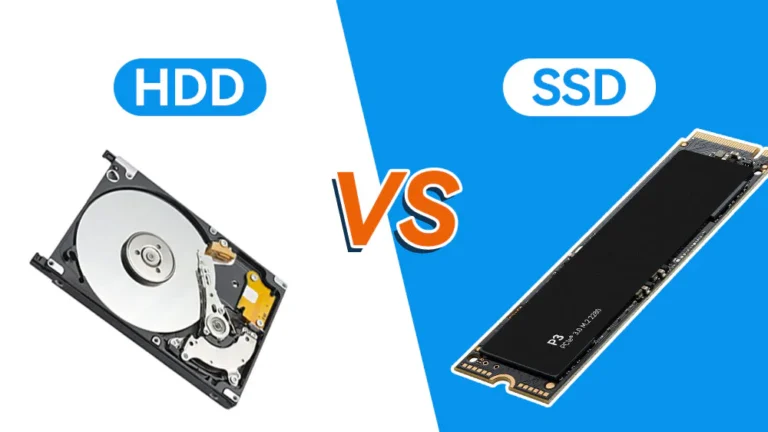
SSD: Unscrew the standoff on the existing SSD, swap it, and screw the new one in.
Reattach the bottom case.
Time: 7 minutes. Difficulty: Trivial. This process extends the laptop’s useful life by years.
Performance & Daily Usability
You’re not buying a compromised machine for the sake of repairability. The Framework Laptop is a bona fide, high-performance ultrabook.
Performance: With configurations up to Intel Core Ultra processors and fast DDR5 RAM, it handles professional workloads (software development, photo editing, dozens of browser tabs) with ease. It’s not a dedicated gaming laptop, but it’s powerful for its class.
Display & Build: The 13.5-inch 2256×1504 display is sharp, color-accurate, and has a 3:2 aspect ratio excellent for productivity. The aluminum chassis feels rigid and premium, rivaling the best in the industry.
Battery Life: Battery life is competitive but not class-leading. The trade-off for modularity is a slight efficiency penalty versus fully integrated designs. You get a full workday, but not much more.
Software & Drivers: Framework provides clear guides and all necessary drivers on its website. Installing a fresh copy of Windows or Linux is straightforward, as all hardware uses standard, well-supported components.
The Verdict: Who Is This For?
The Framework Laptop is a landmark achievement, but it’s not for everyone.
You Should Buy This Laptop If:
You are morally or practically aligned with the right-to-repair movement.
You want to “future-proof” your investment and plan to keep the laptop for 5+ years.
You are a tinkerer, student of IT, or someone who values self-sufficiency.
You want to minimize your personal e-waste.
You appreciate a company that publishes 3D CAD files of its parts and fosters a community of user innovation.
You Might Look Elsewhere If:
Your absolute top priority is the longest possible battery life in an ultrabook.
You want the absolute cheapest entry-level laptop (Framework’s upfront cost, while fair, is higher than some sealed competitors).
You have zero interest in ever opening an electronic device and prefer the convenience of manufacturer service.
Conclusion: A Blueprint for the Future
Using the Framework Laptop is a profound experience. Every time you effortlessly upgrade a part, you feel a sense of agency and ownership utterly absent from the rest of the tech world. It proves that the industry’s trade-offs—between sleekness and serviceability, between profit and planet—are not laws of physics, but choices.
Is it perfect? No. But its minor compromises in battery life are far outweighed by its monumental achievement in design ethics. The Framework Laptop is more than a tool; it’s a statement. It demonstrates that a sustainable, user-respectful future for technology is not only possible—it’s already here, ready to be opened up, upgraded, and owned in the truest sense of the word. It is, quite simply, the right way to build a laptop.