Processor Showdown 2026: Snapdragon vs. MediaTek vs. Apple A-Series – Who Rules the Silicon Throne?
The heart of every smartphone is its processor—or more accurately, its System-on-a-Chip (SoC). For years, the battle for mobile supremacy has been a two-horse race between Qualcomm and Apple, with MediaTek often seen as the budget-friendly alternative. In 2026, that narrative has been completely rewritten. MediaTek has clawed its way into the flagship conversation, Apple continues to flex its custom silicon muscle, and Qualcomm is fighting to defend its crown with aggressive new architecture. This is the ultimate processor showdown.
The Contenders: Meet the 2026 Heavyweights
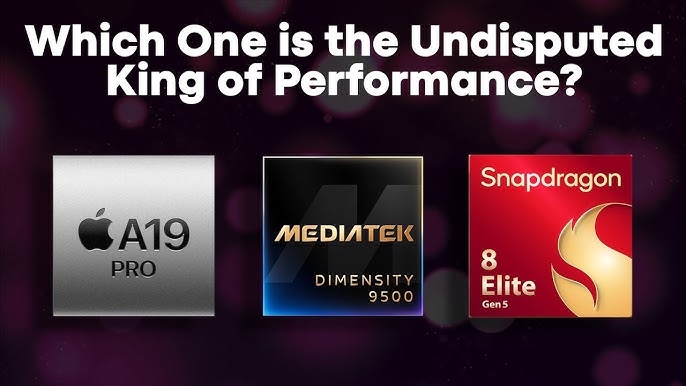
Before diving into benchmarks and real-world performance, let’s introduce the main players vying for a spot in your next smartphone .
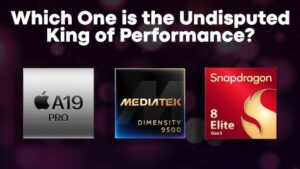
Qualcomm Snapdragon 8 Elite Gen 5: Qualcomm’s latest flagship aims to reclaim the performance crown with its custom Oryon CPU cores. It boasts a powerful 2+6 core configuration running at blistering speeds of up to 4.6 GHz.
MediaTek Dimensity 9500: Once an underdog, MediaTek’s new flagship is its most ambitious yet. It leverages ARM’s latest CPU designs in a unique 1+3+4 configuration and is making significant strides in GPU and AI performance.
Apple A19 Pro: Apple’s latest silicon powering the iPhone 17 Pro continues its tradition of industry-leading single-core performance and unmatched efficiency, thanks to its deeply integrated custom cores and advanced TSMC process node.
Here’s how their core specifications stack up against each other:
Data compiled from
Performance Deep Dive: Benchmarking the Best
Spec sheets only tell part of the story. To see who truly wins, we turn to real-world benchmark data from devices powered by these chips: the Vivo X300 Pro (Dimensity 9500), the OnePlus 15 (Snapdragon 8 Elite Gen 5), and the iPhone 17 Pro (Apple A19 Pro) .
CPU: The Battle of Brains
Geekbench 6 Scores
Analysis: Apple maintains its legendary lead in single-core performance, which translates to the snappy, instantaneous feel of launching apps and scrolling through interfaces . However, in multi-core workloads, the Snapdragon 8 Elite Gen 5 pulls ahead, showcasing the brute force of its eight high-performance Oryon cores. The Dimensity 9500 trades blows, nearly matching the Snapdragon and surpassing the A19 Pro in multi-core, proving it is no longer a distant third place .
GPU and Gaming: A New Contender Emerges
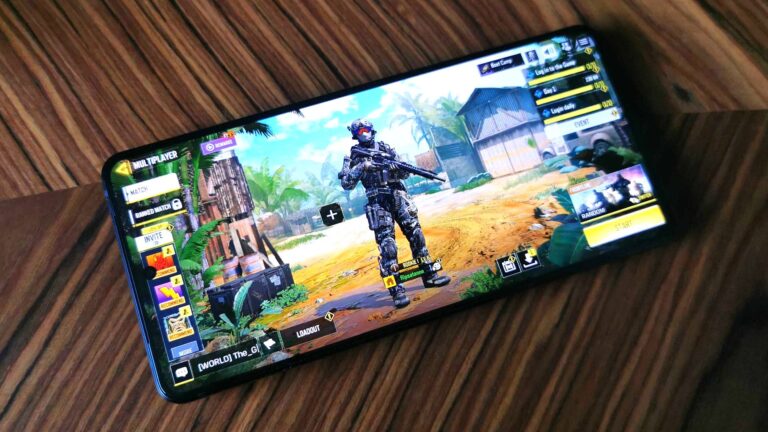
For gamers, the GPU is the star of the show. Here, the results are surprising.
3DMark Scores
Analysis: The Snapdragon 8 Elite Gen 5 takes a narrow lead in the standard Wild Life Extreme test, showcasing its raw graphics power. However, the story flips in the Solar Bay test, which measures ray tracing performance—the holy grail of mobile gaming visuals. Here, the Dimensity 9500 scores a decisive victory, outperforming both competitors by a significant margin . This suggests that for the most graphically advanced games of 2026 and beyond, a Dimensity 9500-powered phone might offer the most visually immersive experience.
The Real-World Rankings: AnTuTu Flagship List
Synthetic benchmarks are useful, but they are just one data point. The monthly AnTuTu flagship list aggregates average performance scores from thousands of real users, providing a “wisdom of the crowds” perspective.
The January 2026 list reveals a fascinating dynamic :
Top-Tier Dominance: The Snapdragon 8 Elite Gen 5 is a powerhouse, powering eight of the top ten highest-scoring Android phones. The specialized gaming phone RedMagic 11 Pro+ claims the top spot with an average score exceeding 4.1 million .
MediaTek’s Strong Showing: The Vivo X300 Pro, powered by the Dimensity 9500, secured a very impressive second place, proving that MediaTek can compete at the absolute highest level .
Key Takeaway: While Qualcomm has the sheer volume of design wins at the very top, MediaTek has proven it can build a chip that sits right alongside—and sometimes outperforms—the best from its rival.
The Mid-Range Shake-Up: Where MediaTek is Winning
While the flagship battle is fierce, the war for volume is won in the mid-range. And here, MediaTek is dominating. The latest AnTuTu sub-flagship (mid-range) performance list tells a stark story :
MediaTek’s Lockdown: MediaTek chips occupy the top seven spots on the performance chart.
The New King: The newly launched Dimensity 8500 Elite, found in phones like the Honor Power2, breaks through the 2.2 million score barrier, setting a new standard for the segment .
Qualcomm’s Struggle: In contrast, competing Snapdragon 7-series chips are trailing by a significant margin, with performance gaps exceeding one million points . This gives MediaTek a commanding lead in the “premium mid-range” category.
MediaTek’s success here is driven by bold architectural choices. The Dimensity 8500, for instance, uses an “all big core” design with eight Cortex-A725 cores, ensuring consistent, high-level performance for demanding tasks like gaming and multitasking .
The Shift in Strategy: It’s Not Just About Nanometers Anymore
For years, the story was simple: a smaller transistor node (e.g., 3nm to 2nm) meant better performance and efficiency. In 2026, that narrative is evolving. Industry leaders like Apple, Qualcomm, and MediaTek are realizing that architectural innovation is just as important as the manufacturing process .
Consumers no longer get excited by a simple “20% faster” claim on a slide. They care about real-world smoothness and battery life. This has led to a massive focus on:
Caching: Massive increases in CPU cache memory allow the chip to access frequently used data faster, boosting performance and efficiency without relying on a smaller process node . For example, the Dimensity 9500s is reported to feature up to 19MB of CPU cache .
Power Efficiency: Apple’s A19 Pro efficiency cores, for instance, reportedly achieved a 29% performance boost at virtually the same power draw through architectural refinement alone . This focus on efficiency is what delivers all-day battery life, even under heavy use.
The Verdict: Which Chip is for You?
So, after all the benchmarks and analysis, who wins? The answer, as always, depends on what you value most.
For the Uncompromising Power User: The Snapdragon 8 Elite Gen 5 still leads in raw multi-core CPU performance and has the widest array of flagship phones. If you want the absolute highest-scoring device on paper, Snapdragon is your bet .
For the Mobile Gamer and Tech Enthusiast: The Dimensity 9500 is the dark horse winner. Its stellar ray tracing performance and impressive CPU scores show that MediaTek is not just competing—it’s innovating. It offers the most exciting blend of cutting-edge features and raw value .
For the Seamless Ecosystem Experience: The Apple A19 Pro remains in a league of its own. It offers best-in-class single-core performance, unparalleled efficiency, and tight integration with iOS. You don’t buy an iPhone for a spec sheet; you buy it for the holistic experience, and the A19 Pro is the perfect engine for that .
In 2026, there are no bad choices, only different ones. The real winner is the consumer, who gets to enjoy a level of competition that is pushing mobile technology forward faster than ever before.